SPOILER: it was a complete failure
all my self hosted infrastrucutre, including this site (!), runs on a raspberry pi 4 i had lying around. since it is already power efficient, and my traffic is modest that it remains sufficient for my needs, i want to add a lot of storage for it so i can use it as a NAS. the cheapest das i could find costs £130 to buy, and only for 4 drives. i found this massively overpriced; it's a glorified powered usb hub, surely it shouldn't cost that much?
using 4x3.5" drives (at a minimum), each drive should draw about 8W ( source), but assume 10W for some room to breathe. 4*10 = 40W. issue: psus are most efficient at ~50% of their max power, and even the most modest psu is 200w... or so i thought. looking around, i found a so called picoPSU: they're perfect. i couldn't actually find efficiency curves for them, but it's safe to assume that somewhere around 50%.
...
except, 4x3.5" drives take 12V and 2A startup current, which makes for 12 * 2 * 4 = 96W. this IS only during startup however, so in terms of efficiency, it's still better to use an 80W psu, and attempt staggered spin up so only 1 drive draws max current at a time... but it remains unclear on how to do that exactly. it seems it must either be supported by BIOS and/or the SATA controller itself, neither of which i have any control over
these are all fairly resolvable problems, at worst i can just use an overpowered psu and take the efficiency loss, but the bigger problem is that LITERALLY ALL SATA to USB adapters don't only occupy the 7 pin data port, but also the 15 pin power port. this means i can't even connect the sata power cables from the psu to the drives while using a SATA to USB adapter, the only apparent alternative being the usage of a separate power brick for each drive in order to supply the 12V that 3.5" drives need, as USB can only supply 5V... gross
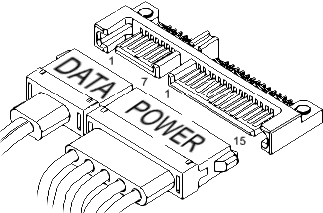
doing more research, i found out that "usb port multipliers" do in fact exist. for example, boards with JMB575. this is perfect, as the board gets its power via usb, and the drives get their own power and connect to the board.
i got a 5 port sata multiplier, that uses JMB575 for port multiplication and JMS580 as SATA to USB controller; it was the only model i could find. unfortunately, i was getting speeds of around 30MB/s with this setup, even with only one drive connected, which is totally unaccpetable even for my modest internet speeds...
so, this turned out to be a complete failure. the whole setup (without a case, as i didn't even get to begin designing that) WOULD have cost <£70, likely costing less if i bought all parts of off aliexpress for example, making it viable, but the speeds i got are unacceptably slow. so, it looks like i have to make a different nas (not rpi 4) with sata directly on the motherboard. i liked the raspberry pi for its power efficiency and small footprint, but i can actually do something much more performant with similar idle power, as a home server is idling most of the time, if the correct hardware is picked. modern cpus can achieve surprisingly low idle consumption compared to their max TDP... plus that gives more headroom for more traffic and performance. we'll see what i can do... until then, postponing nas shenanigans and continuing on this pi